
Why Skills, Not Job Titles, Now Drive Business Performance


How UK Employers Can Build Capability in a Changing Labour Market
The UK labour market is undergoing a fundamental shift away from rigid job titles towards skills-based working. In an era of rapid technological change, hybrid working patterns and evolving customer demands, roles are evolving faster than traditional workforce planning can keep up. As Julia Hobsbawm, a leading expert on the future of work and founder of Workathon, puts it:
“The future of work is not about jobs, but about skills and how quickly organisations can adapt them.” – Julia Hobsbawm
In practical terms, this means that competitive advantage now comes from capability, not just headcount. A job title might describe someone’s general responsibilities, but it’s their skills that determine performance and adaptability. Majority of UK employers prioritise skills-based hiring over traditional recruitment criteria such as degrees and past job titles (People Management). Customers and investors are less concerned with how many people you employ, and more focused on your organisation’s capacity to deliver results – which increasingly depends on having the right skills in place.
Why Skills-Based Working Matters
Research underlines the urgency for this shift. The World Economic Forum (Future of Jobs Report 2023) estimates that over 50% of employees globally will need reskilling or upskilling at some point in their careers. In fact, if the global workforce were represented by 100 people, 59 would require reskilling by 2030, with many at risk of redundancy without it.
This is being driven by rapid automation and digital transformation. Roles in areas such as AI, data science and cybersecurity are expanding, while more routine or clerical jobs are in decline – trends clearly outlined in WEF (Fastest Growing Roles). These developments are already evident in the UK, where skills shortages persist across multiple sectors despite active recruitment, as reported by CIPD.
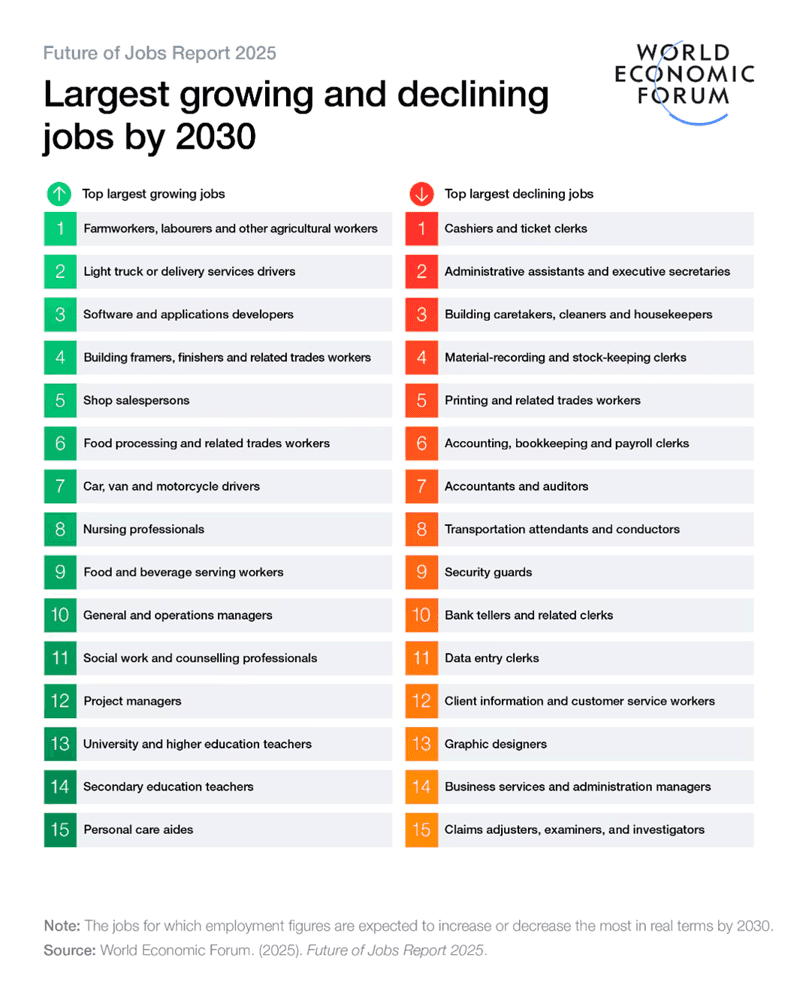
Image source: Word Economic Form
n the UK, research shows that skills mismatches persist, with employers reporting that applicants often lack key skills even when recruitment activity is high, indicating a deeper challenge beyond simple candidate volume (Employer Skills Survey).
According to CIPD’s latest Resourcing and Talent Planning survey, 83% of organisations that tried to recruit in the past year struggled to find the right skills. The most common response was to upskill existing staff – a clear sign that internal capability building is becoming essential.
Further CIPD research shows that the UK suffers from a skills and qualification mismatch: nearly half of workers may be in roles for which they are over- or under-skilled. This contributes to persistent vacancies and suggests that recruitment alone won’t fix the problem. Unless the underlying skills gap is addressed through training, development and reskilling, workforce challenges will continue.
Capability Over Headcount: Rethinking Workforce Planning
For UK employers, the shift towards skills-based working means it's time to rethink traditional workforce planning. Instead of fixating on job descriptions and headcount, the focus now is on capabilities. A skills-led organisation identifies, develops, and deploys the right skills to meet its goals, rather than simply filling roles.
This approach has real benefits. Companies can respond more quickly to shifting demands. For example, one tech firm believed it had a shortage of cybersecurity talent. In reality, the skills already existed across departments. Once they mapped employees' abilities beyond job titles, they unlocked 40% more capacity, without hiring anyone new.
A capability focus also brings learning and development into the spotlight. Instead of hiring externally for every skill gap, employers can build these capabilities internally through training, mentoring, or on-the-job learning. This helps future-proof the workforce and embeds a culture of continuous learning.
The Benefits of a Skills-Led Organisation
A skills-based approach helps organisations become more adaptable and future-ready. Key benefits include:
Greater agility
UK employers with strategic skills planning are more likely to invest in workforce training and development, improving organisational adaptability (CIPD).Better use of talent
Mapping employee skills reveals hidden capabilities, reducing the need for external hires.Higher retention and engagement
Organisations that invest in skills and training often experience higher retention and engagement among employees, according to UK skills policy research (CIPD).Stronger succession planning
Building talent pools around key skills ensures continuity when roles change or leaders move on.
The Big Picture: Skills Drive Performance
Organisational performance depends more on how well skills are identified, grown and used than on job titles. Asking, "Do we have the capabilities to meet our goals?" leads to more effective planning than asking, "How many people do we need for this job?"
Businesses that invest in skills are more adaptable and innovative. They're also more attractive to talent, especially as workers increasingly seek employers that support growth and progression.
By contrast, organisations clinging to rigid job models risk falling behind. Skill gaps widen, employee satisfaction dips, and the ability to respond to change is weakened.
From Job-Centric to Skills-Centric: A Quick Comparison
For a clear illustration, here’s a comparison between a traditional job-based approach and a skills-based approach to managing people:
Traditional Job-Centric Approach | Modern Skills-Based Approach |
|---|---|
Hire and assign people strictly by job title and fixed role descriptions. | Hire and deploy people based on their skills and potential, often allowing fluid roles. |
Workforce planning focuses on headcount numbers for each department. | Hire and deploy people based on their skills and potential, often allowing fluid roles. |
Training is occasional and role-specific (to fill current job requirements). | Training is continuous and skill-specific (to prepare for evolving and future needs). |
Career progression follows a fixed ladder within a department. | Career progression is non-linear – people move across projects and roles to develop diverse skills. |
Succession planning identifies one replacement per role, often externally hired. | Succession planning develops pools of internal talent with key skills, ready to step up when needed. |
Job performance is evaluated against static job descriptions. | Performance is evaluated on skill growth, adaptability, and contributions across various initiatives. |
As the table suggests, moving to a skills-centric model requires cultural change and thoughtful management, but the benefits in agility and capability can be significant.
Top Skills for the Future of Work
The World Economic Forum’s Future of Jobs Report 2025 shows that the pace of change in the global labour market is accelerating, driven by technological innovation, economic shifts and evolving business models. Employers around the world are prioritising upskilling and reskilling to prepare their workforces for this new reality. The report finds that nearly 39 % of current core skills will be transformed or become outdated by 2030, and that continuous learning is essential to remain competitive and resilient (Linkedin).
Top 10 Fastest-Growing Skills to Prioritise
According to the World Economic Forum’s Future of Jobs Report 2025, employers worldwide expect both technical and human skills to grow sharply in importance through to 2030 as job roles evolve and nearly 40 % of existing skills change. Technology skills such as AI, big data and cybersecurity are expected to see rapid demand growth, but human skills like creative thinking, resilience and leadership will remain critical. (World Economic Forum press release)
Top 10 Fastest-Growing Skills by 2030:
AI and Big Data – fluency with artificial intelligence and data analysis is now foundational.
Networks and Cybersecurity – securing increasingly connected systems is critical for resilience.
Technological Literacy – comfort with digital tools and emerging tech is a baseline competency.
Creative Thinking – original problem solving and innovation remain uniquely human strengths.
Resilience, Flexibility & Agility – the ability to adapt quickly to change is in higher demand.
Curiosity & Lifelong Learning – continuous skill refreshment is essential for future roles.
Leadership & Social Influence – guiding teams and influencing outcomes still matters.
Talent Management – understanding how to attract, develop and retain people is a strategic skill.
Analytical Thinking – interpreting complex information to make decisions is a core capability.
Environmental Stewardship – sustainability understanding is increasingly business-critical.
These skills span both technology and human-centred capabilities, reflecting that future workforces must combine digital proficiency with adaptability, critical thinking and interpersonal strengths to stay competitive (World Economic Forum press release).
How Rendstaff Programmes Support Future-Ready Skills
At Rendstaff, our programmes are designed to help organisations and professionals build the capabilities highlighted in the WEF’s report, relevant programmes we currently offer include:
Gen AI for Productivity (Digital Applications Technician) – developing practical digital and AI skills that boost workplace performance, aligned with technological literacy and analytical thinking.
Business Analyst (Level 4) – strengthening critical analytical and problem-solving skills essential for data-driven decision-making.
Marketing Manager & Marketing Executive – enhancing creative thinking, customer focus and digital fluency.
Multi-channel Marketer / Digital – building digital capability across modern marketing channels.
People Professional & HR Support – focused on talent management, empathy and leadership development.
Team Leader & Operations Manager – fostering leadership, resilience and adaptability in operational contexts.
Procurement & Supply Chain Practitioner / Procurement & Supply Assistant – applying analytical thinking and process optimisation skills in supply-centric roles.
By aligning learning investment with the skills employers value most, these programmes help bridge the gap between workforce capability and future performance.
Conclusion
In the UK’s changing labour market, success belongs to organisations that treat skills as their most valuable asset. By adopting a skills-led mindset, employers can build a workforce that is agile, engaged and future-ready.
For learners, this means focusing on developing adaptable, transferable skills. For employers, it means rethinking hiring, training, and talent management. The payoff is a more resilient organisation, better business outcomes, and stronger alignment with the future of work.



Related Courses
Related Courses









Faq
001
Are apprenticeship programmes only for entry-level roles?
No. Apprenticeships run from Level 3 to Level 7, including management and leadership roles.
002
Can apprenticeship programmes support existing staff, not just new hires?
Yes. Most employers use apprenticeships to upskill and retain existing employees.
003
Will this distract teams from their day-to-day role?
No. Apprenticeship programmes are designed around real work and to complement it, not time away from it.
004
How do we know which programme is right for us?
We assess your business priorities and connect you with a programme that will deliver a measurable impact.
005
What about funding and the apprenticeship levy?
We guide you through maximising the apprenticeship levy, funding options and compliance.
006
Do we have to choose a training provider ourselves?
No. We connect you with vetted, high-quality learning providers that fit your needs.
007
What other support is available to businesses taking on apprentices?
As well as connecting your team to the right programmes based on your skills gaps, we:
Handle the logistics and details on funding and your responsibilities
Provide ongoing learner support and business guidance throughout the programme.
008
Is this suitable for small or growing businesses?
Absolutely. Apprenticeships are one of the most cost-effective ways to build capability with any size of business.
009
How long does an apprenticeship take?
The right apprenticeship programme will be matched to the job role and business goals and depends on the level and complexity of the apprenticeship. however on average they take between 12-18 months.
010
What makes Rendstaff different?
We are learning provider neutral and our advice is based on what’s right for your business.
001
Are apprenticeship programmes only for entry-level roles?
No. Apprenticeships are open to new starters and experienced professionals at any stage of their learning journey and generally offer a structured route to more senior roles.
002
What programme levels are available?
From Level 3 through to Level 7, including degree-equivalent pathways with in-demand skills that employers value.
003
Will I receive support throughout the programme?
Yes. We guide you from initial advice through to enrolment, with clear support at every step. You will receive quality learning and mentorship with your tutor throughout the programme.
004
Do I choose the training provider?
We connect you with high-quality programme providers that best support your learning and progression on your growth journey.
005
Do I have to pay anything towards my apprenticeship programme?
No. The cost of your training is met by the employer who is able to access support from the government.
006
Will it help me build and develop my professional network?
Yes. You will be tutored by industry experts from day one and your programme will provide you with valuable networking opportunities and mentorship.